Everything to know before walking New Zealand's most celebrated day hike — distance, timing, conditions, and how private touring changes the experience.
The Tongariro Alpine Crossing is routinely named among the best single-day hikes anywhere in the world, and having walked it more times than we can count, we understand why. Over 19.4 kilometres, the track carries walkers across the saddle between two active volcanoes, past steaming vents and turquoise crater lakes, and down through native forest to the valley floor. It sits inside Tongariro National Park — New Zealand's oldest national park and one of the few places on earth to hold UNESCO World Heritage status for both natural and cultural significance.
What the Crossing Actually Involves
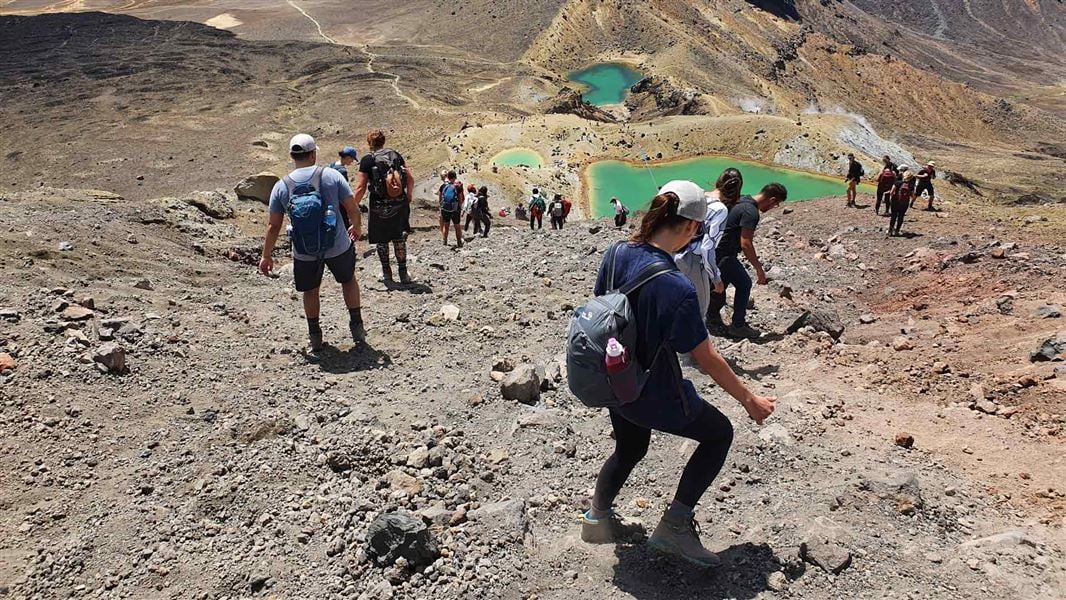
The full track takes most walkers seven to eight hours, climbing from 1,120 metres at the Mangatepopo end to 1,886 metres at Red Crater before descending to Ketetahi at 760 metres. It is a point-to-point walk, not a loop, which means transport at both ends is essential — this is one of the main reasons independent visitors end up booking a shuttle regardless of how they arrived. The terrain shifts constantly: boardwalk through the Mangatepopo Valley, a steep climb known locally as the Devil's Staircase, the exposed volcanic saddle at the top, then a long descent past the Emerald Lakes and Blue Lake before forest reappears near Ketetahi.
Conditions and Bookings
The Department of Conservation now operates a booking system for anyone using any part of the track, including those on guided walks or shuttles. It's worth noting that two fires moved through sections of Tongariro National Park in late 2025, and the crossing reopened in November with some areas showing burn damage alongside early regrowth — a restorative rāhui remains in place over the affected area at the request of local hapū. None of this affects the safety or availability of the walk itself, but it does mean the landscape looks different from older photographs, and guides are briefed to explain the context respectfully on the day. Weather remains the more immediate factor: conditions on the exposed saddle can turn quickly, and a "not recommended today" advisory is issued when winds, temperature, or snow make the crossing genuinely hazardous.
Why Private Touring Changes the Day
Most of what makes the crossing difficult to plan independently isn't the walking — it's the logistics around it. Parking at Mangatepopo is extremely limited and closed to visitors doing the full crossing during peak season; a shuttle is effectively mandatory. Start times matter, since arriving too late in the day means finishing in poor light, and arriving too early in peak season means joining the largest crowds on the track. With Elite New Zealand, collection happens directly from your Taupō or Ōhakune accommodation at a time chosen to avoid the busiest window, and the return transfer is waiting at Ketetahi rather than requiring you to coordinate a second vehicle or shuttle booking of your own. On days when conditions aren't right for the full crossing, the itinerary shifts to the surrounding volcanic plateau instead, so the day isn't lost to weather.
Getting Ready
The crossing is graded moderate, but it is a genuine alpine walk — proper footwear, layered clothing, sun protection, and enough water for a full day out are all essential regardless of season. Even in summer, temperatures at Red Crater can sit well below those at the trailhead. Guests touring with us are briefed on exactly what to bring before the day, so nothing is left to guesswork.
Every Elite New Zealand experience is arranged exclusively for your group. No shared vehicles, no group schedules — just your journey, your way.
Begin Your Enquiry